
FASHION IN A TIME OF CRISIS
By Thea Elle | March 09, 2026 | Cultural CapitalFashion is often dismissed as trivial in moments of upheaval. Wars begin, economies falter, governments harden their borders, and somewhere in Paris or Milan a designer still debates the width of a skirt.
When the world fractures, hemlines speak
At first glance it seems absurd, even indulgent. Yet clothing has always been more than ornament. It is one of the ways societies reveal how they are coping with pressure. Silhouettes shift when circumstances shift. Hemlines, in their quiet way, record history.

English Women, WWII. Rationing narrowed the silhouette but sharpened the posture. Utility clothing turned scarcity into discipline, proving that even under government regulation style could survive.
When fabric becomes strategy
During the Second World War fashion was pulled directly into the machinery of the state. In Britain, the government introduced the Utility Scheme, a program that regulated how garments could be made. Fabric was rationed, details were limited, and clothing carried a small “CC41” label indicating that it complied with wartime production rules. In the United States, similar restrictions appeared under the War Production Board’s Regulation L-85. Cuffs disappeared, pleats were reduced, and the civilian wardrobe tightened to conserve material for military use.
The result was not ugliness. It was discipline. Skirts narrowed, shoulders sharpened, and civilian dress began to echo the geometry of military uniforms. Fashion, for a time, stopped behaving like a playground of abundance and began acting like infrastructure. It adjusted itself to the state's priorities. The lesson for the luxury industry was unmistakable: beauty can survive scarcity, and fashion—like any other business—learns how to operate within systems of power.
Rosie the Riveter and the Feminist Shift
The war also quietly altered the gender map of the wardrobe. Millions of women entered factories, shipyards, and engineering jobs, and clothing followed them there. The image of Rosie the Riveter captured a shift that fashion alone could never have engineered.
Work demanded practicality. Trousers, once controversial for women, became common in factories and shipyards. Headscarves replaced elaborate hairstyles around machinery. What began as necessity gradually reshaped expectations. After the war, the memory of those uniforms remained. Crisis had quietly expanded the boundaries of everyday dress.
Make an icon yours.
Shop Preloved Luxe now.
The Return of Excess
Two years after the war ended, fashion swung dramatically in the opposite direction. In 1947, the young couturier Christian Dior presented a collection that journalists quickly named the “New Look.”
After years of rationing, DIOR’s dresses used extravagant amounts of fabric. Skirts expanded outward, waists tightened, and shoulders softened. The silhouette seemed almost provocative in its abundance.
The change was not only aesthetic. Post-war France needed exports and cultural prestige. Couture became a national economic strategy. Luxury goods brought foreign currency into a rebuilding country, and Paris reclaimed its status as fashion capital. In that moment, luxury began functioning as a modern economic instrument. Beauty became policy.
Crisis Does Not Eliminate Beauty
History repeatedly shows that hardship does not erase elegance. During the Great Depression, when unemployment reached catastrophic levels, Hollywood’s evening gowns became even more luminous. Satin dresses glowed across cinema screens while breadlines formed outside. The spectacle mattered. It offered a temporary vision of another world.
Even today, in places experiencing conflict or instability, small rituals of appearance remain. People polish shoes, iron shirts, and adjust collars. These gestures may appear minor, but they carry weight. Clothing preserves dignity. It quietly insists that life continues.
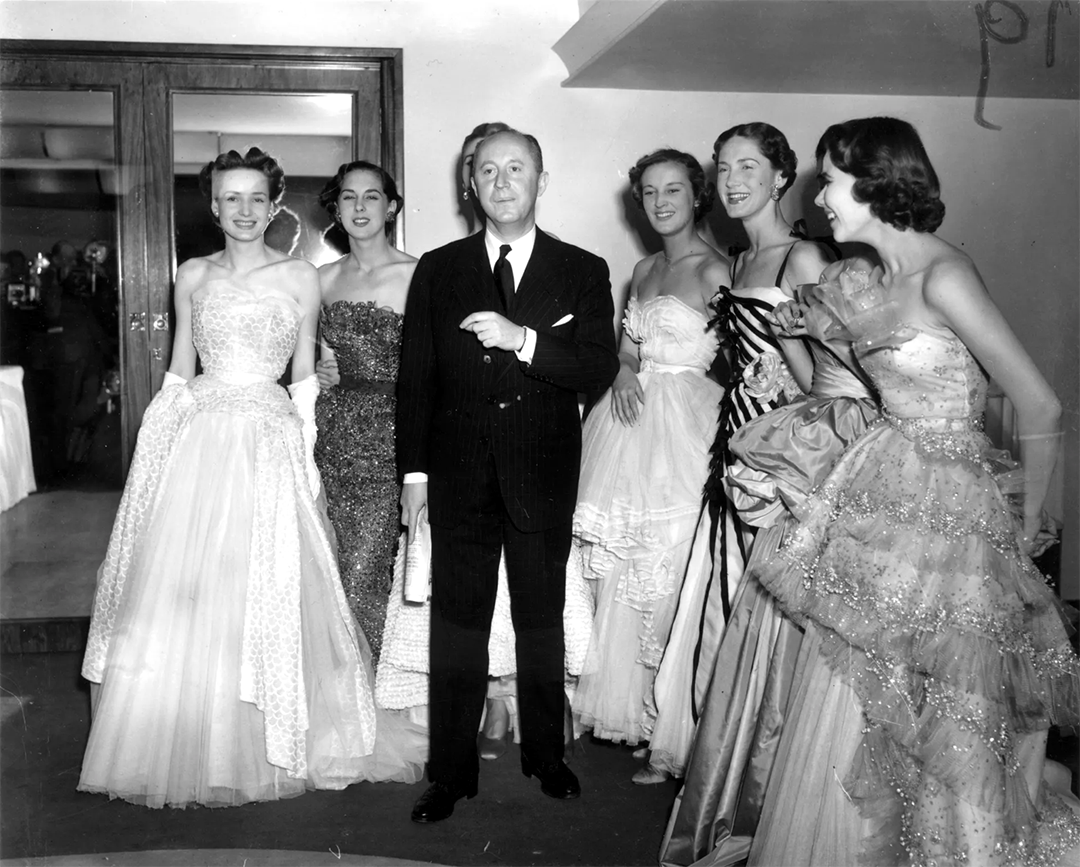
Christian Dior, 1947.After years of rationing, Dior answered austerity with excess. The New Look was more than a silhouette; it was a signal that Paris, and luxury itself, were returning to the world economy.
The Austerity Cycle
Economic instability often pushes fashion in two directions at once. One impulse favors restraint—clean tailoring, muted palettes, quiet fabrics. The other moves toward spectacle, toward glitter and exaggeration. When systems feel fragile, some people withdraw into understatement while others embrace theatrical display.
Fashion absorbs both instincts. It translates anxiety into form, turning emotional pressure into visible style.
Curated Finds. Timeless Style,
Thoughtfully. CRIS & COCO.
Quiet Luxury After the Financial Crisis
The global financial crisis of 2008 produced one of the clearest modern examples of this shift. In the years before the crash, fashion celebrated conspicuous display. Logos were large, signals of wealth unmistakable. After the banking system collapsed, the mood changed. Overt excess felt uncomfortable.
Designers responded with subtlety. Craftsmanship replaced branding. Tailoring became discreet. The aesthetic now called “quiet luxury” began to take shape.
At the same time luxury goods acquired a new economic narrative. Objects such as the Hermès Birkin bag increasingly circulated in discussions about resale value and investment.
Luxury had entered the language of finance. Handbags appeared in auction catalogs, analysts tracked their prices, and rare accessories began behaving like portable assets. The Luxury Industrial Complex had adapted again, repositioning beauty as stability.
Fashion as Economic Seismograph
Fashion often reacts to economic conditions with surprising sensitivity. Periods of inflation tend to coincide with maximalism, recessions with restraint. Moments of social liberation frequently shorten hemlines, while more conservative eras lengthen them again. These patterns are not rigid laws, but they appear often enough to suggest that clothing reflects the psychological weather of its time.
The body becomes a quiet indicator of collective mood.

Hermès Birkin. In the age of financial anxiety, luxury learned a new language. The Birkin bag became not only a status object but a portable asset—where fashion meets finance inside the modern Luxury Industrial Complex.
The Infrastructure of Beauty
The idea that creativity emerges purely from destruction is appealing but incomplete. Post-war fashion depended on functioning textile mills, renewed investment, and international markets ready to buy again. DIOR’s famous silhouettes were possible because materials, capital, and logistics had returned.
Even the most poetic dress depends on supply chains. Beauty, like any industry, requires infrastructure.
Why it matters now
Today we live through another extended period of instability. Geopolitical tension, economic volatility, and climate uncertainty shape the background of daily life. Fashion does not resolve these forces, but it reflects how societies process them. Some wardrobes move toward understatement and durability. Others amplify spectacle.
Every outfit becomes a small signal of how people imagine the future.
Beauty Never Fully Withdraws
In times of crisis beauty rarely disappears. It changes scale or tone, sometimes retreating into subtle codes, sometimes expanding into theatrical display. But it remains present.
Fashion is not simply consumption. It is the choreography of identity under pressure.
When the world shifts, silhouettes shift with it.
Editorial Luxury Awaits