
LETTER TO
A FASHIONISTA
On developing an eye and keeping your own counsel
Dear fashionista,
The new documentary Karl has given me a welcome excuse to return to Karl Lagerfeld, CHANEL’s longtime artistic director and the creative mastermind behind its reinvention. Watching a clip this morning about fashion, style, and creativity, I thought of Rilke’s lovely Letters to a Young Poet. Something in that insistence on curiosity and independent judgment deserved its own letter, addressed to anyone who enjoys clothes and wants to develop an eye for them. You may be eighteen, seventy, or politely declining to answer; the wardrobe has no admissions office.
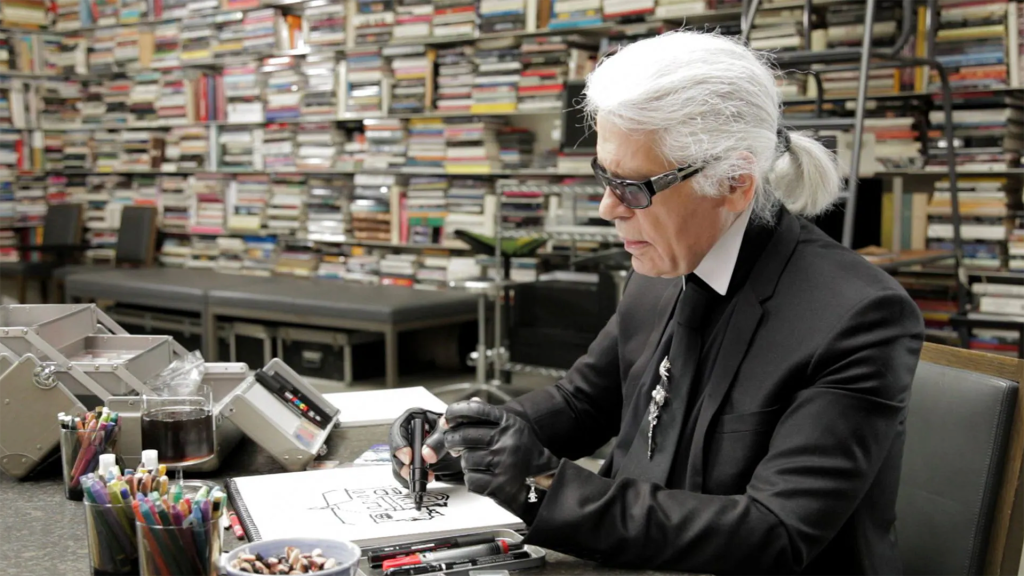
Karl Lagerfeld at work in his studio, sketching in his signature black suit, sunglasses, and gloves.
Karl still impresses me. The creativity, the talent, the appetite for work: that combination is rare. He could also be remarkably annoying. Admiring someone does not oblige you to agree with everything that comes out of their mouth; in Karl’s case, that would have required a considerable administrative department. What fascinates me is how, after decades in fashion, he remained so curious, so inventive, and so astonishingly prolific.
A useful change of scale
Years ago, in China, I found myself preparing a talk on fashion intelligence while privately wondering whether I possessed any intelligence at all: My partner Andrea and I had separated, our business had ended, and I found myself in the midst of an existential crisis, struggling to figure out how to move forward.
I had stayed in touch with a Chinese Polytechnic, and when they invited me to speak, declining hardly felt possible; I needed both the relationship and the money, which are excellent motivators and rather poor remedies for stage fright. I had never given a talk, never written one, and certainly didn’t feel qualified to deliver Develop Fashion Intelligence: in my version of our partnership, my partner Andrea had the style, while I was her business sidekick, now arriving to teach with a business that no longer existed.
Looking back, I had seriously underestimated my own creativity and drive, but at the time I had to invent the talk before I could believe in the person giving it.
One slide asked for ten ideas a day, including silly ones. Another suggested taking a 30 RMB bag and imagining it as a 3,000 RMB bag, then reversing the exercise. Change leather to canvas, metal to plastic, symmetry to something askew. Small details could become large; large things could become small. Looking at the slides now, I am amused by how much still resonates. Apparently, some ideas survive the business that helped produce them.
The distinction between fashion and style matters because the industry sells individuality while depending on people following its lead. It needs you to want what it offers. Your task is to develop enough judgment to accept an offer, change it, or decline it without spending the afternoon wondering whether you have offended fashion.
Being informed is only the beginning
You can know every collection and still struggle to choose a jacket. Information tells you what is happening. Taste develops when you begin deciding what you think about it. The new bag may be wonderful. It may also be wonderful on somebody else, which is a perfectly satisfactory place for it to remain.
This is where rules become tempting. What is elegant? What should I wear at this age? Is this color allowed? Rules promise to decide for you. Unfortunately, they also make it for thousands of other people. Soon, everyone expresses individuality through the same approved exception.
Study proportion, color, construction. Learn why something works. Then use that knowledge to make a choice. You will occasionally choose badly. So will people with much larger budgets. The useful question is what you noticed, what you missed, and what you would change. A mistake you understand can teach you more than an outfit that received unanimous approval.
Borrow the language and change the sentence
Admiration often begins with imitation. You notice someone’s glasses, haircut, silhouette, and think you have found the secret. But copying Karl’s glasses will give you Karl’s glasses. The rest of Karl is a bigger challenge.
What deserves study is how the elements belong together, and why they belong to that person. Different fashion houses have different visual languages; learning to recognize them gives you something to work with. The same applies to your own wardrobe. Borrow a proportion. Change the context. Combine it with something the original designer would never have invited to lunch.
This is where the remix exercise becomes useful in everyday styling. Change the proportion, the material, the company a piece keeps. Try something formal with something casual; move a familiar accessory into an unfamiliar role. If you make things, enlarge a pocket until it changes a jacket. If you dress yourself, let one detail change the balance of an outfit. Try the opposite, too: reduce an elaborate idea until one element carries it. The interesting discovery may already be in your wardrobe, awaiting better company.
My old style dictionary ranged through Punk, Ivy League, New Romantics, Goth, K-pop, Manga, Safari, and American Sportswear. Each offers shapes, associations, a way of carrying yourself. You can borrow from several without applying for membership in any of them. Keep your own dictionary: collect colors, textures, gestures, and references, and notice what attracts you. Over time, the relationships become more interesting than the individual entries. That is when influences start becoming something of your own.
Money should have a supporting role
Money can buy extraordinary craft. Beautiful fabric and the skill of the hands that shape it deserve admiration. I have spent too much of my life around fashion to pretend otherwise. But a magnificent garment still needs someone to decide what to do with it.
Andrea, my former partner, had a great eye. She understood fashion, could dress very simply, and could look like a few thousand dollars without spending them. She mixed high and low because she saw how things worked together. We also had a special affection for PRADA. Independent taste does not require you to stop loving labels. It does require the label to make a convincing contribution.
Look at the whole picture. Where does your eye go? What happens between the shoulder and the shoe? Does the jewelry help, or would it prefer a separate press conference? Six beautiful things can become six competing arguments. Sometimes removing one allows the others to make sense.
That is no campaign for compulsory minimalism. Extravagance can be marvelous. The point is to notice whether each element contributes, and to recognize when you are finished. Buying another thing is easy. Leaving a beautiful thing behind takes a little more independence, especially when the shop has arranged excellent lighting around your indecision.
Your eye needs to get out more
If fashion is your only reference, your work will eventually resemble work that already resembles something else. Look at paintings, photographs, buildings, furniture. Watch old films. Read books without asking whether they will improve your personal brand. Notice people who have never considered having one.
A doorway can teach you something about proportion. A badly matched room can contain a color combination you would never have invented. Something you initially find ugly may become fascinating when you understand what it is doing. You do not have to approve of everything. You do have to look before dismissing it.
This matters more than appearing endlessly confident. Confidence without observation can become a very well-dressed form of incuriosity. Give yourself time to notice. Ask why an image holds your attention, why another leaves you cold, why two people in almost identical clothes make entirely different impressions.
Then work with what you have noticed. Karl’s work ethic is part of what I admire, and my old slides emphasized daily practice. You do not need his schedule to learn from that. Try a different combination, take a photograph, notice what changes when you move. If you make things, sketch or rearrange an idea before waiting for a better one. Regular attention gives the eye something to work on. A folder called Inspiration cannot do all the work indefinitely.
The ten-ideas exercise still appeals to me. Write possibilities down before judging them: a color you would usually avoid, a different use for something familiar, a combination that sounds faintly ridiculous. You need not wear all ten to the supermarket. Give yourself enough alternatives to discover that your first answer was only your first answer.
A signature should leave room to move
A recognizable style is useful. It saves time and gives your choices continuity. But you should still be able to surprise yourself. The version of you that found a successful silhouette does not need to supervise every future decision.
Life changes. Your body changes, your work changes, the places you live change. Something that once felt daring can become an old habit. You can keep the parts that still interest you and alter the rest. You're not obligated to replace yourself every season, but there is little pleasure in becoming the curator of your own permanent exhibition.
The rules about dressing for your age have always struck me as particularly absurd. Apparently, there is a brief interval between being too young and too old when you may wear interesting clothes. I hope somebody tells you when it starts. Meanwhile, ask whether the thing still feels like you, whether the proportion works, whether you enjoy wearing it.
Getting older can give your taste more definition. You know more about what you dislike, which saves time. Keep that clarity, but remain curious. Rejecting everything new on principle is simply another way of letting the calendar choose your clothes.
Give the clothes someone to dress
You can study an outfit closely and still miss the person wearing it. Presence has something to do with the relationship between the two: how a person carries a decision, how naturally the clothes belong to their life. It does not require a loud personality. Someone quiet can hold your attention completely.
Two people can wear the same things and come across very differently. One may feel at home in the choice; another may seem to be waiting for a verdict. An expensive coat cannot settle that uncertainty. Develop interests, do things, acquire opinions worth revising. Give yourself a life that provides the clothes with something to express.
Perhaps that is what brings me back to Rilke’s title, and to the talk I gave while trying to find my own way forward. Advice becomes useful when you can do something with it in your own circumstances. You can practice, experiment, and develop judgment at any age, including the judgment to disagree with a person whose talent you admire.
So look carefully, try things, and change your mind when you see a reason. If you are stuck, take a small thing and make it large. If it becomes ridiculous, find out whether the ridiculousness is useful. There may be an idea in it; there may only be an enormous pocket. Either way, you have given yourself another possibility.
Fashion will continue offering possibilities. You can enjoy them while deciding which ones deserve a place in your life or your wardrobe. Read the label by all means. Just leave yourself enough room to sign your own name.
Yours, Cris